
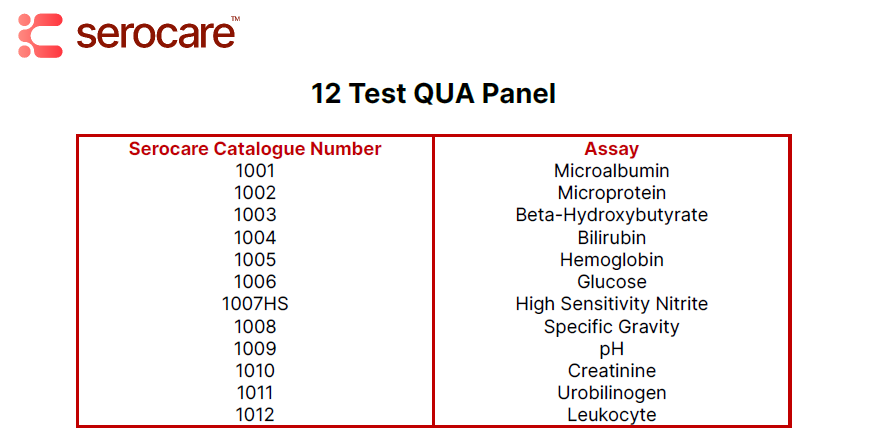
12 QUA Test Panel
Infections

Nitrite is a byproduct of bacteria’s conversion of Nitrate in the urinary tract.
In normal conditions, most of the small fraction of filtered proteins are reabsorbed and metabolized by the proximal tubule cells and are normally present in urine in trace amounts. However, high levels of protein in urine may be an indication of kidney disease or immune disorders.

Leukocyte Esterase is an enzyme present in certain white blood cell, which the body uses to flight off an infection or foreign threats.
It is a useful tool to help identify an infection or inflammation. During an infection, as part of the body’s immune response, white blood cells will move towards the area to defend it. High levels in urine may be an indication of an infection in the bladder, but could also be a sign of kidney infection.
Kidney Functions

Proteinuria is elevated protein in the urine.
In normal conditions, most of the small fraction of filtered proteins are reabsorbed and metabolized by the proximal tubule cells and are normally present in urine in trace amounts. However, high levels of protein in urine may be an indication of kidney disease or immune disorders.

A microalbumin test detects for small amounts of albumin in urine.
Healthy kidneys prevent albumin from entering urine as it is a protein used for important functions such as building and repairing muscles. Albuminuria of 30 to 300mg/day is an indicator of early renal disease and glomerular injury.

Creatinine is a normal waste protein produced by the body. Normal ranges for creatinine ranges between 500-2000mg/day, depending on age, lean body mass, and diet.
Abnormal results can be due to mild conditions such as muscle breakdown or high meat diet, or severe conditions such as kidney problems or urinary tract obstruction. In addition, it is often preferred to express microalbumin test result relative to the amount of creatinine in urine, as it provides a more accurate categorization of Albuminuria.
Liver Functions

Bilirubin is a byproduct of old red blood cells breaking down, and is processed by the liver to produce bile, a fluid that helps with digestion.
A healthy liver regulates the amount of bilirubin in blood and removes it from the body. A liver that’s not functioning properly will result in elevated bilirubin levels in blood, which eventually gets eliminated in urine.
Urobilinogen is a degradation product of bilirubin metabolism in the intestine.
Normally, most of the urobilinogen is excreted out of the body through stool. But small amounts are recycled back into the bloodstream and are excreted into urine. Higher than normal levels in urine may be an indication of hemolysis, liver disease. Lower levels in urine may be an indication of bile duct obstruction.
Diabetes

Glucose is the main type of sugar in blood and is also the main source of energy for the body.
Normally, glucose is not present in urine. However, when excess amount of glucose is present in blood, the kidneys will eliminate the excess glucose through urine. High levels of glucose in urine may be an indication of high blood glucose levels and/or a problem with kidney function.
Ketones are produced in the liver during fatty acid metabolism.
When the body doesn’t get enough glucose for energy, body fats will be used to produce energy, which results in an increase of ketone in blood and urine. Beta-hydroxybutyrate is the predominant ketone body present in severe diabetic ketoacidosis.
Others
Hemoglobin is a protein in the red blood cells.
In normal conditions, most of the small fraction of filtered proteins are reabsorbed and metabolized by the proximal tubule cells and are normally present in urine in trace amounts. However, high levels of protein in urine may be an indication of kidney disease or immune disorders.
Urine specific gravity is a measure of solutes concentration in the urine. It may be used to provide information on the kidney’s ability to concentrate urine.

Urine pH is a measure of how acidic/ basic the urine is
In normal conditions, most of the small fraction of filtered proteins are reabsorbed and metabolized by the proximal tubule cells and are normally present in urine in trace amounts. However, high levels of protein in urine may be an indication of kidney disease or immune disorders.